
Capital Firewall in Practice: Four Steps to Stop Business Cash Flow From Entering Your Home
Most veteran owners understand the concept — this post closes the implementation gap with four concrete steps you can begin this week.
Most months, Marcus runs a tight ship. The business is profitable, the team is paid on time, and on paper, everything looks solid. But there was that one Tuesday in November when a client delayed a payment by three weeks, a piece of equipment needed a repair that could not wait, and the business account landed at a number that made him uncomfortable.
The home account was right there.
He moved $2,400 over — just to smooth it out, just this once. He told himself he would put it back when the payment cleared. He did. But three months later, a slow January meant the same thing happened again.
This is not a discipline problem. It is not a budgeting problem. It is a structural problem.
The boundary between the business and the household does not hold because there is no structure in place to make it hold. Good intentions are not enough.
The firewall is not built by trying harder — it is built by setting up four specific things in a specific order.
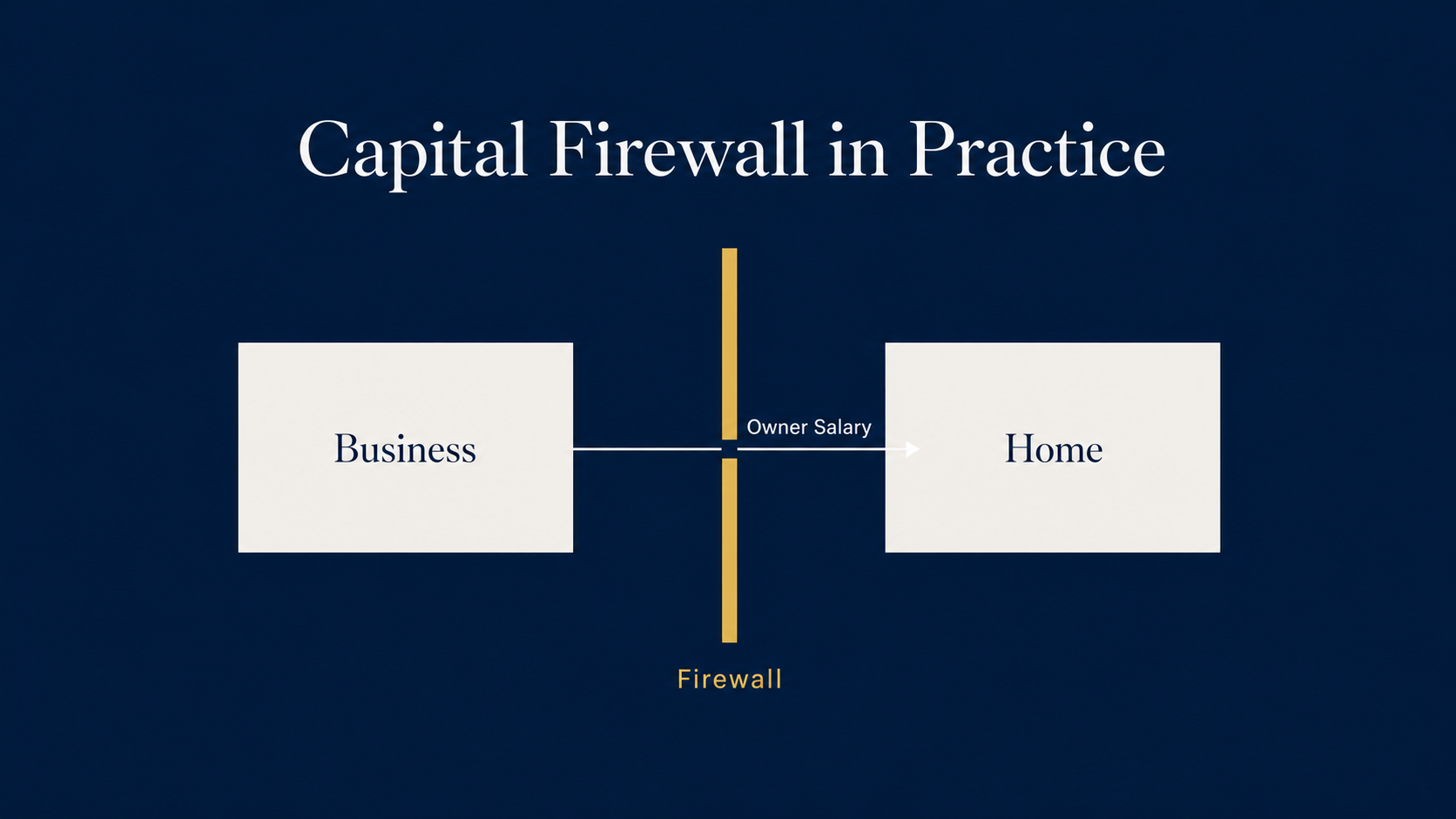
A Capital Firewall is a deliberate, structured separation between business cash flow and household cash flow.
The business pays the owner a consistent, defined salary.
The business maintains its own operating reserve.
The household maintains its own emergency fund.
The two pools do not freely mix.
When something goes wrong in the business, it hits the business reserve — not the family's savings account. If you want the full conceptual framework, read our earlier posts on the Capital Firewall.
This post assumes you understand the idea and are ready to build it.
Step 1 — Define and Lock Your Owner Salary
The most common way business cash flow bleeds into the household is through informal draws. The owner takes what the business can afford that month. Some months that number is generous. Other months it means a short draw and a quiet raid on the personal account.
The fix is not complicated, but it does require a commitment: set a defined monthly owner salary, treat it exactly like a payroll expense, and pay it consistently — whether the month was strong or soft.
Here is how to arrive at a reasonable number:
Start with a conservative estimate of your average monthly revenue over the past 12 months — not your best months, not your worst, a real average.
Subtract your operating expenses: payroll for your team, rent, insurance, software, and anything else you pay to keep the doors open.
Whatever remains is your margin. Your owner salary should come from that margin, set at a level the business can reliably sustain, with room left over to fund the reserve you will build in Step 2.
This salary should feel modest at first, not because you do not deserve more, but because the goal in the early months is consistency over size. A $9,000-per-month salary paid every month without fail is more valuable to your household than a $14,000 draw paid some months and a $4,000 draw in others.
Consistency is what the firewall runs on.
Step 2 — Build a Business Operating Reserve
The reason owner pay gets disrupted is that the business does not have a cushion of its own. When a slow month arrives or a receivable runs late, there is nothing standing between the shortfall and the owner's paycheck. So the household absorbs it. That is the leak the firewall is designed to seal.
The fix is a dedicated business operating reserve — held in a separate account from your main operating account, and completely separate from any personal savings. The target is 60 to 90 days of total operating expenses. If your business costs $40,000 per month to run — including owner salary — your target reserve is $80,000 to $120,000. That number may feel large at first. You do not fund it overnight.
The practical approach is a percentage set-aside. Each month, before you do anything else, move a fixed percentage of revenue — 5 percent is a reasonable starting point — directly into the reserve account. Treat it as an operating expense, not an optional contribution. Once the reserve reaches the target, you maintain it there.
The behavioral rule is what matters most: if the business reserve is intact, the owner salary gets paid.
If the reserve gets drawn down, you and your planner work the problem from the business side. The household stays out of it. That rule is the firewall doing its job.
Step 3 — Open a Dedicated Household Account
The firewall requires a mirror structure on the personal side. The owner salary — and only the salary — feeds the household operating account.
Business distributions, year-end bonuses, or irregular payments go into a separate personal savings account and stay there until you make a deliberate decision to deploy them. They do not automatically flow into day-to-day household expenses.
The account structure looks like this:
A business operating account for daily business activity,
A business reserve account held separately,
A household operating account funded solely by the owner salary,
A household reserve or savings account for irregular business income and personal emergencies.
That structure prevents the two specific emergencies that break owner-operated households.
The first is the household funding the business — which is what happened to Marcus in November.
The second is the business distributing cash into the household in a strong month, inflating the family's spending baseline, and leaving them exposed when the business slows down.
The dedicated household account creates a clean line. The household runs on the salary. Everything else is optional and deliberate.
Step 4 — Set a Monthly 15-Minute Review
The firewall does not maintain itself. Without a regular check, small violations accumulate — a transfer here, a personal charge on the business card there — and the structure quietly erodes.
The practice that keeps the firewall intact is simple: a 15-minute monthly review.
In that review, you confirm three things.
First, was the owner salary paid consistently and on time?
Second, is the business reserve at or above the target level?
Third, did any personal funds move into the business, or any business funds move into the household, outside the defined salary?
This is not a bookkeeping session. It is a brief, structured check on whether the firewall is holding.
If everything is clean, it takes five minutes. If something is off, you catch it early when the fix is still small.
Over time, the review also builds a picture of your cash flow patterns — the seasonal dips, the strong quarters, the expense clusters — that becomes genuinely useful when you sit down with a planner to map out what is next.
Why This Sequence Matters
The steps are ordered for a reason.
The salary comes first because it anchors everything else — without a defined salary, there is no clean line to protect.
The reserve comes second because it is the buffer that allows the salary to hold when the business has a difficult month.
The household account structure comes third because it creates the boundary that makes the salary meaningful on the personal side.
The review comes last because structure without accountability drifts.
This is not about restriction. It is about visibility and control.
When the business and the household each have their own lane, decisions get cleaner, stress drops, and the financial picture becomes something you can actually plan from. That is what the Capital Firewall is designed to do — and these four steps are how you build it.
Ready to See Where You Actually Stand?
If you are running a business that is profitable on paper but your household still feels like it is one slow quarter away from stress, you are not alone — and you are not doing anything wrong. The structure just is not in place yet.
The first step is not a product or a pitch — it is a clear snapshot of where your business and home front actually stand.
Start with the Free Readiness Review.
Afterward, we’ll review it together in a 45-Minute Readiness Review Walk-Through, and you can walk away with a written set of options you can put in front of your family and your team.