
FAQ:
Secure On Every Front
For Veteran Business Owners
1. Working with us
-
Secure On Every Front is a three‑track planning system built specifically for veteran‑owned businesses where your house front, team, and eventual exit all depend on your company.
It’s designed to help you:
Stabilize the home front so your family is not carried by the business alone.
Strengthen team‑driven enterprise value and reduce founder dependence.
Plan your exit on purpose—not under pressure.
You do not have to carry that entire mission by yourself.
-
This planning program is built for veteran‑owned, service‑based businesses with roughly 4–50 employees and meaningful owner income.
Many of the businesses we designed this system for:
Hold SDVOSB, VOSB, or HUBZone certifications.
Operate in government contracting, staffing, healthcare, or professional services.
Our research shows common client profiles include:
Cash‑Strapped Commander – profitable on paper, but the home front feels fragile; owner pay is inconsistent and personal savings or VA‑related income have supported payroll.
Growth‑Trapped Mission Leader – revenue has grown, but the business is still heavily dependent on the founder; turnover and thin benefits drag on valuation.
Exit‑Focused Legacy Builder – a large portion of net worth is locked in the business; exit paths, certification implications, and after‑tax outcomes are not yet clear.
If your family, team, and retirement are tightly tied to one business, this planning is built for you
-
Most advisors focus on either personal finance or the business—rarely both in one integrated plan.
Secure On Every Front connects:
Household security and owner compensation
Team design, benefits, and retirement plans
Veteran‑specific incentives and tax opportunities
Valuation and exit strategy
inside one fiduciary framework, so decisions at home, in the business, and around your exit are all working toward the same mission.
Our work is life‑first: your values, mission, and timeline drive the plan—not a product or portfolio.
-
Plan For Your Goals LLC is a fiduciary, State of Florida registered investment adviser, which means we have a legal obligation to put client interests first.
Our compensation comes from clearly disclosed advisory fees—such as planning fees and, where applicable, asset‑based fees—paid by our clients.
We do not receive commissions from product providers for recommendations.
That structure is designed so you can focus on making the best decisions for your family, team, and exit, without wondering whether a recommendation is driven by a product commission.
Any planning “commitments” we make refer to the planning process and service delivery, not to investment performance, tax results, or any specific financial outcome.
-
Think about which description sounds most like your situation right now:
Track I – Mission Capital Blueprint (Stabilize the home front)
You may be a good fit for Track I if:
Owner pay is inconsistent, or personal savings / VA‑related income have plugged payroll.
There’s no clear line between business risk and family security.
Your spouse or family feels like you are “one bad quarter away” from a crisis.
Track II – Team Valuation Command (Strengthen team and enterprise value)
You may be a good fit for Track II if:
The business is profitable and growing, but still heavily dependent on you as the founder.
You’re worried about key‑person risk, turnover, or thin / underused benefits that hurt retention.
You want your team, benefits, and retirement plan to support higher valuation and a smoother future exit.
Track III – Walk-Away Authority Project (Plan the exit on purpose)
You may be a good fit for Track III if:
A meaningful share of your net worth is locked in the business.
You are thinking seriously about timing, deal structure, or succession, and how these choices affect SDVOSB, VOSB, or other certifications.
You want to understand after‑tax outcomes, walk‑away floors, and certification‑sensitive options before committing to a transaction.
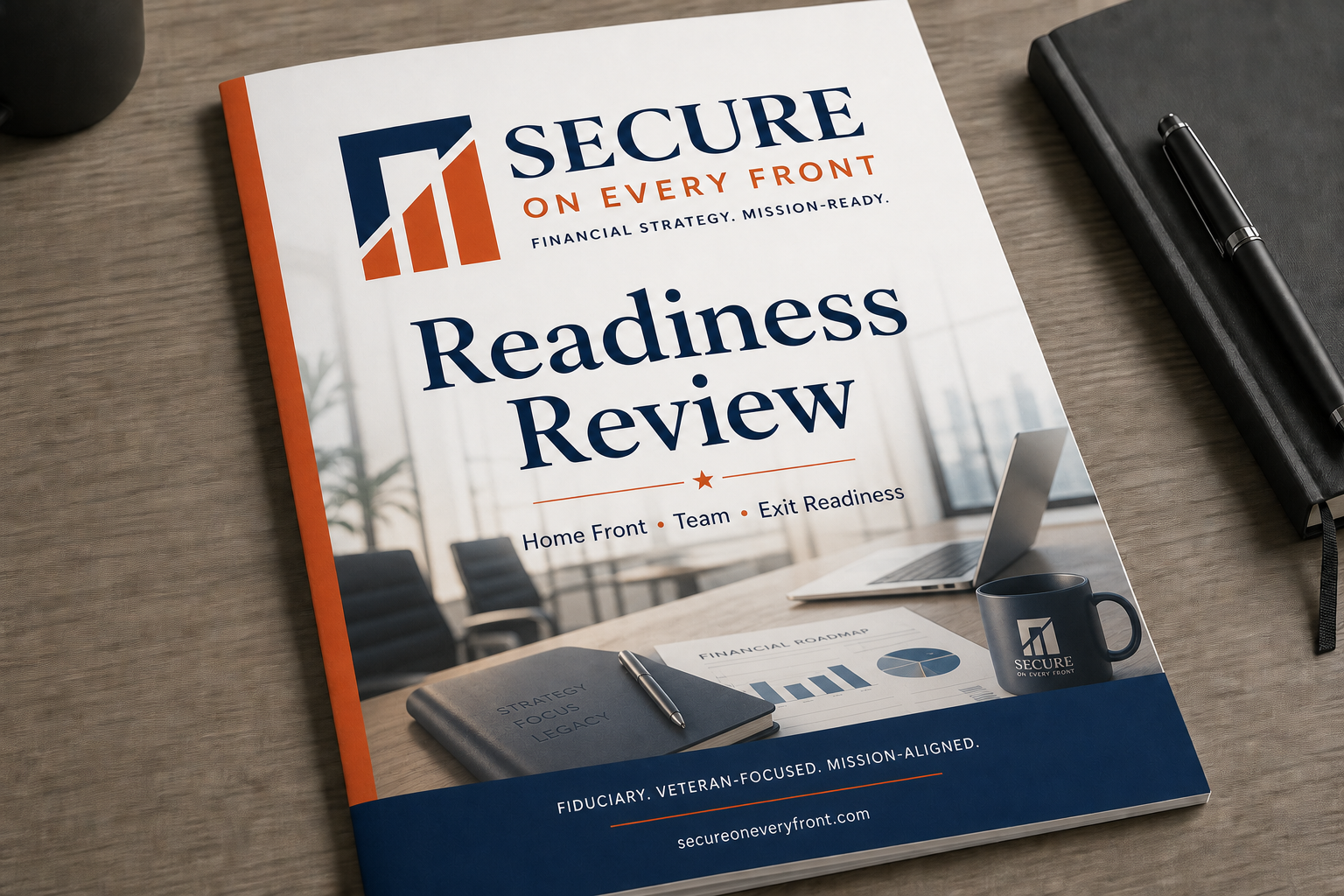
If more than one description fits, that’s normal. The best way to pinpoint your starting track is to complete the online Readiness Review interview. You will receive a plain-english report providing information designed to highlight your household, team, and transition pressure points.
2. Track I: Mission Capital Blueprint - Owner pay and household stability
-
Based on our research with veteran owners, common starting points in Track I – Mission Capital Blueprint include:
Inconsistent owner pay and periods where you’ve used personal savings or VA‑related income to plug payroll.
A lack of clear separation between business risk and family security—the household rises and falls with the business.
Feeling like a future sale is “survival money” rather than upside because the home front feels fragile.
Track I is designed to organize owner pay, stabilize the household, and draw a clear line between family stability and business risk so a future exit becomes a choice, not a scramble.
-
In Track I, we combine business‑owner planning with household financial planning so your family isn’t carried by the business alone.
Typical focus areas include:
Clarifying owner compensation patterns and creating a more disciplined owner‑pay structure.
Building a “Capital Firewall”—a clear separation between household reserves and business cash flow—so a business shock doesn’t immediately become a household crisis.
Defining a safety‑first income floor for the household so you know what must be protected before reinvesting more aggressively in the business.
Identifying and coordinating tax credits, veteran incentives, and benefit opportunities with your tax advisor so they’re applied in a coherent plan, not in isolation.
Rather than a long generic checklist, our first 30 days are structured to focus on early clarity around owner pay, household fragility, and potential ‘capital leaks’ that may warrant attention.
-
Practically, Stage I usually looks like:
An online Readiness Review interview to surface household and business pressure points.
A 45-Minute Readiness Review Walk-Through going over those findings together and set priorities.
A focused project (typically 2–4 months) where we:
Build or refine your owner‑pay plan.
Establish the Capital Firewall and household reserves targets.
Decide how much capital can safely be reinvested into the business over time.
The goal is to leave you with reduced household fragility, cleaner owner cash flow, and a clearer path for using tax and benefit opportunities, not just more spreadsheets.
3. Track II: Team Valuation Command - Team, benefits, and retirement plans
-
Yes. For firms with roughly 4–50 employees, we help you evaluate structures such as:
SIMPLE IRAs
SEP IRAs
401(k) and Safe Harbor 401(k) plans
When appropriate, pooled plans or state‑facilitated options
We look at owner savings capacity, employee retention, administrative bandwidth, and available tax credits (including SECURE‑era startup incentives) so the plan fits your cash flow, your team, and your long‑term goals, not just the current tax year.
-
Yes. For some employers, Track II – Team Valuation Command can include an annual team session that combines:
Financial wellness education in plain English
Discussion of how pay, benefits, and the retirement plan fit together
The goals are to:
Reduce financial stress on the team
Improve understanding and use of benefits
Connect these decisions to retention and enterprise value
We can coordinate these sessions around your existing open enrollment or other key calendar points.
-
The C2H (“Connecting Heads to Hearts”) workshop is an annual team development session that focuses on how your culture, communication, and benefits support the long‑term health of the business and your people.
It is led by Teresa Roberts, an experienced facilitator in team dynamics and communication.
It is coordinated with your Track II – Team Valuation Command work so leadership, team dynamics, and financial benefits are all tied back to retention and enterprise value.
Think of it as a practical, people‑focused way to support the same goals we’re working toward in your financial and benefits design.
-
For many Track II engagements, a core team session is included in the advisory scope as part of aligning benefits with retention and enterprise value.
Additional or more specialized workshops can be added as a separate project, scoped in advance so you know the timing, cost, and expected outcomes.
-
We are structured to complement—not replace—your existing professionals.
Especially in Track II and Track III, our role is to:
Help assemble and coordinate a “deal team” of tax, legal, benefits, and M&A specialists when needed.
Provide planning memos and coordination briefs that clarify your objectives, constraints, and next steps.
The goal is for everyone to be working from one coherent, owner‑approved plan, not pulling in different directions.
4. Track III: Walk-Away Authority Project - Exit and certification sensitive issues
-
No.
Owners can come to us years before an exit to:
Stabilize the household and owner pay (Track I).
Start reducing founder dependence and strengthening the team (Track II).
Others will begin in Track II or Stage III when retention problems, certification‑sensitive contracts, or time‑sensitive exit decisions are already on the table.
Track III – Strategic Retirement Project is about clarity and readiness, not just an immediate sale.
-
Yes. In Track III, we help you:
Compare exit paths and timing, including options that may affect SDVOSB, VOSB, or other veteran certifications tied to contracts.
Stress‑test how different deal structures could impact your household, retirement plan, and certifications.
Coordinate with your CPA, attorney, benefits specialists, and other advisors so everyone is working from the same after‑tax scenarios and walk‑away floors.
The goal is to help you step away on purpose, with a clear understanding of what you’re walking toward, what you’re walking away with, and what you’re protecting.
5. Common Concerns from Veteran Owners
-
You start with an online Readiness Review Interview that highlights household, team, and transition pressure points in plain English.
Then, in a focused 45-Minute Readiness Review Walk-Through (online):
We discuss those findings together.
Clarify your priorities and timing.
Decide whether Track I, II, or III is the right starting point before any ongoing engagement begins.
There is no obligation to move forward beyond that conversation.
-
That is extremely common among otherwise successful veteran‑owned businesses.
Track I is designed to create order out of that mess, not to judge it. We use the Readiness Review and early Track I work to:
Get a clear baseline of income, owner pay, and key risks.
Prioritize what actually matters first, rather than asking you to fix everything at once.
Messy starting points are assumed—not disqualifying.
-
No.
Our research shows many Exit‑Focused Legacy Builders simply want to:
Understand their options and timelines.
See how certifications, team continuity, and family security would be affected by different paths.
Avoid being forced into a rushed sale because of burnout, health, or market shifts.
Track III is about building authority and readiness well before a transaction, so you’re not making the biggest financial decision of your life under pressure.
-
Yes.
Most owners will begin with a Track I project to stabilize the home front, then decide whether to move into Track II or Track III based on what they learn and how their priorities evolve.
We scope work around your current mission and bandwidth, not an all‑or‑nothing commitment.
-
Our core planning system and positioning—Secure On Every Front—are built specifically for veteran business owners, especially those with SDVOSB, VOSB, HUBZone, or similar considerations.
That focus lets us be more fluent in VA‑related planning, veteran incentives, and certification‑sensitive exits than a generalist advisor.
Get Your Readiness Review
This 13-question assessment takes about 20 minutes and gives veteran business owners a plain-English snapshot of where pressure is building most across three connected areas:
Home Front
Team Strength
Exit Readiness
It is designed to help you spot where your household, your team, or your future plans may be more exposed than they need to be — and where the program should begin.
Plain-English Results
Educational and low-pressure, no commitment required