
S-Corp, QBI, and WOTC: Three Tax Strategies Most Veteran Owners Leave on the Table
Your CPA probably mentioned at least one of these. Here is why they matter more when they work together.
You filed your taxes this year and wrote a check that felt too big. Or maybe your CPA mentioned something about an S-Corp election, or a deduction you might qualify for, but the conversation moved on before it ever turned into a plan. You are not alone. Most veteran business owners I talk with have heard pieces of this — a strategy here, a credit there — but nobody has ever laid them out side by side and shown how they connect.
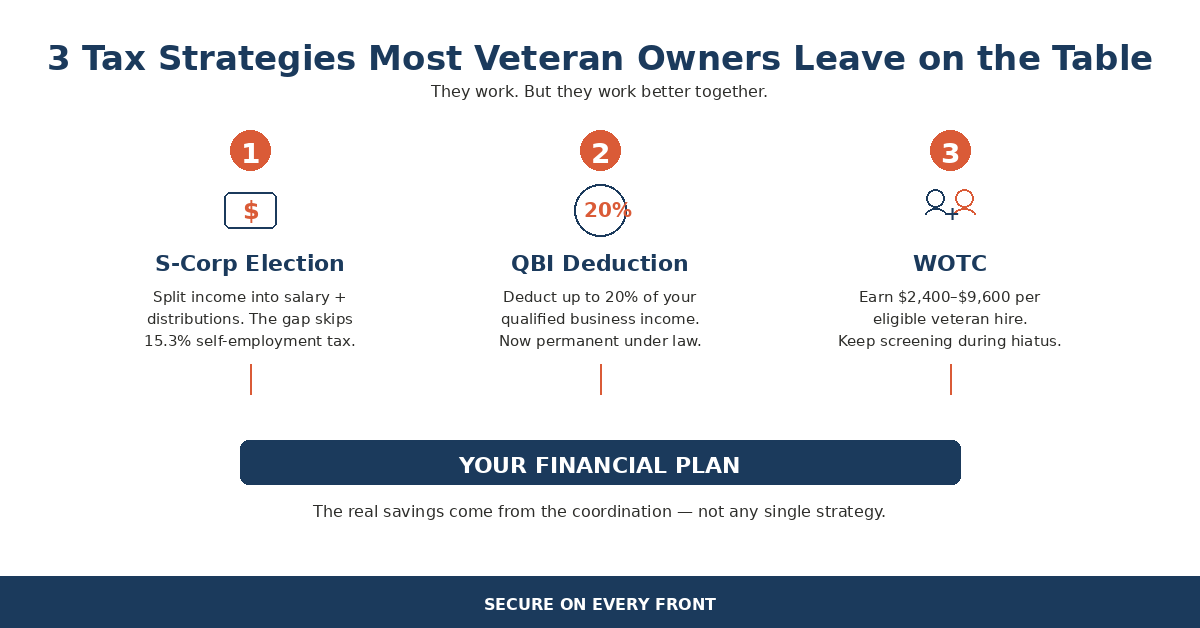
That is the gap this post is designed to close. Three specific tax strategies — the S-Corp election, the Qualified Business Income (QBI) deduction, and the Work Opportunity Tax Credit (WOTC) — can each reduce your tax bill on their own. But when they are coordinated with your owner pay, your entity structure, and your hiring plan, the combined effect is significantly larger than any one of them alone.
None of these are secrets. They are just rarely connected.
Strategy 1: The S-Corp Election — Pay Yourself on Purpose
If your business is set up as a standard LLC, every dollar of net profit is subject to self-employment tax — currently 15.3 percent (12.4 percent for Social Security plus 2.9 percent for Medicare). That applies whether you take the money home or leave it in the business.
An S-Corp election changes that math. As an S-Corp, you pay yourself a W-2 salary — which is subject to payroll taxes — and then take any remaining profit as a distribution, which is not subject to that 15.3 percent. The savings come from the gap between your total profit and your salary.
Here is a simplified example. Say your business earns $150,000 in net profit. As a standard LLC, you would owe roughly $21,000 in self-employment tax. With an S-Corp election and a reasonable salary of $75,000, your payroll taxes drop to about $11,500 — and the other $75,000 passes through as a distribution with no additional self-employment tax. That is roughly $9,500 in potential savings before you account for the added compliance costs of running payroll and filing an 1120-S return.
There is an important guardrail: the IRS requires that your salary be "reasonable compensation" for the work you actually do. You cannot pay yourself $30,000 and take $120,000 in distributions without risking penalties, back taxes, and interest. But with proper planning, the S-Corp election is one of the most straightforward ways to reduce what you owe — especially once your business consistently earns above $60,000 to $75,000 in annual profit.
The connection to your Capital Firewall: The salary you set as an S-Corp owner is the same number that anchors your household cash flow plan. When your owner pay is intentional and consistent, your Capital Firewall holds. When it is not, your family absorbs the risk. This is not just a tax decision — it is a stability decision.
Strategy 2: The QBI Deduction — 20 Percent Off the Top
Section 199A of the tax code allows owners of pass-through businesses — sole proprietorships, partnerships, S-Corps, and certain trusts — to deduct up to 20 percent of their qualified business income before calculating federal income tax. Congress made this deduction permanent in 2025 through the One Big Beautiful Bill Act, so it is no longer at risk of expiring.
In plain terms: if your business earns $200,000 in qualified income and you are below the threshold, you may be able to deduct $40,000 from your taxable income. That is a meaningful reduction in your tax bill without changing anything about how your business operates.
For 2026, the full deduction is available to single filers with taxable income below roughly $203,000 and married filing jointly below roughly $406,000. Above those levels, additional limitations phase in — especially for specified service businesses like consulting, law, and financial services. There is also a new minimum deduction of $400 for any owner whose QBI exceeds $1,000 and who materially participates in the business.
The key planning question for most veteran owners is not whether you qualify — it is how to maximize the deduction. And that brings us back to entity structure and owner pay. Because the QBI deduction interacts with your W-2 wages (which your S-Corp pays you), the salary you set can directly affect how much of the deduction you can claim. Set it too low, and you may trigger IRS scrutiny on the S-Corp side. Set it without considering QBI, and you may leave deduction dollars on the table.
The connection: QBI does not exist in a vacuum. It sits on top of your entity structure, your compensation plan, and your business income. An integrated approach — not a one-off tax tip — is what makes this deduction work at full capacity.
Strategy 3: WOTC — A Hiring Credit Most Veteran Owners Never Claim
The Work Opportunity Tax Credit (WOTC) is a federal credit available to employers who hire individuals from specific target groups that face barriers to employment — including fellow veterans. For each eligible veteran who works at least 400 hours, the credit can range from $2,400 to $9,600 in the first year of employment, depending on the veteran's eligibility category. Disabled veterans with longer periods of unemployment can generate the highest credits.
An important update for 2026: WOTC's most recent authorization expired on December 31, 2025, and Congress has not yet renewed it. The credit is currently in a legislative hiatus. However, this is not unusual — WOTC has lapsed multiple times since 1996 and has always been renewed, often retroactively. Bipartisan legislation is currently pending that would extend the credit through 2030 and increase its value. Most tax professionals recommend that employers continue screening new hires and filing the required paperwork (IRS Form 8850) during the hiatus, so that if Congress renews the program retroactively, your hires are already documented and eligible.
For a veteran-owned business with 10 to 50 employees and regular hiring activity, the potential credits can add up quickly — especially when you are already hiring from a veteran talent pool. The process requires certification through your state workforce agency, and the paperwork has a strict 28-day deadline from the employee's start date. Many owners miss it simply because nobody told them it existed or flagged the timeline.
The connection to your team plan: WOTC is not just a tax play — it is a hiring strategy that aligns with your values. As a veteran business owner, you already know the caliber of people coming out of the military. This credit rewards you for doing something you were likely going to do anyway — and it offsets the cost of building the team that reduces your founder dependency.
Why These Three Work Better Together
Here is what happens when you look at S-Corp, QBI, and WOTC as isolated tips:
Your CPA sets up the S-Corp, but your salary has no connection to your household cash flow plan.
You claim the QBI deduction, but nobody checks whether your W-2 wages are optimized for the calculation.
You hire veterans, but nobody files the WOTC paperwork because it was never part of your onboarding process.
Now here is what happens when they are connected inside a plan:
Your S-Corp salary is set based on reasonable compensation and anchored to your Capital Firewall — so your household is stable and your self-employment tax is managed.
Your QBI deduction is calculated with your W-2 wages and entity structure in mind — so you are claiming the full amount you are entitled to.
Your hiring process includes WOTC screening from day one — so every eligible hire generates a credit that strengthens your cash position and supports your team-building goals.
The difference is not one strategy. It is the coordination between them. And that coordination does not come from a tax return — it comes from a financial plan that connects your entity structure, your compensation, your hiring, and your household into one clear picture.
The First Step Is Simpler Than You Think
You do not need to overhaul your tax strategy overnight. You do not need to fire your CPA or start over. You need a clear starting point — one that shows you where your entity structure, owner pay, and hiring practices stand today, and where the gaps are.
That is exactly what the Free Readiness Snapshot is built to do. It is a short, structured review that covers your business and household finances in one pass. No cost, no pitch, no obligation. From there, if it makes sense, you and I can sit down for a Mission Readiness Review and walk through the options — including whether any of these three strategies belong in your plan.
You have earned the right to keep more of what your business produces. The first step is seeing the full picture.