
Mission Briefing: Five Financial Blind Spots Every Veteran Owner Should Check Now
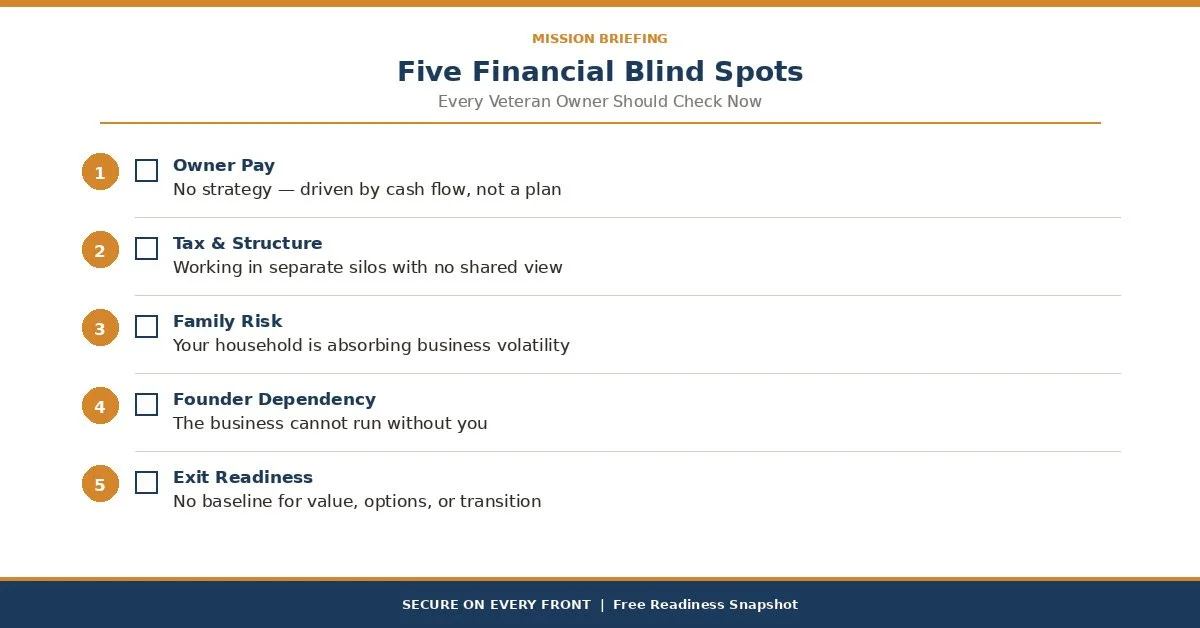
You run a tight operation. But these five gaps may be hiding in plain sight.
You did not get this far by being careless. You built a business, hired a team, landed contracts, and kept everyone paid — often before you paid yourself. Veterans tend to run disciplined operations. The books are clean, the work gets done, and the clients come back.
But discipline is not the same as visibility. And in my work with veteran-owned businesses, the problems that cause the most damage are rarely the ones you see coming. They are the ones sitting quietly in the background — financial blind spots that do not announce themselves until a slow quarter, a key employee resignation, or a serious conversation about selling the business forces them into the open.
This briefing covers the five I see most often. Not all of them will apply to you. But if even one sounds familiar, it is worth knowing where you stand.
Blind Spot 1: Your Owner Pay Has No Strategy Behind It
Most veteran business owners pay themselves whatever is left after expenses, payroll, and taxes. Some months that is generous. Some months it is nothing. The number is driven by cash flow, not by a plan.
That matters more than most owners realize. Inconsistent owner pay creates instability at home — your family’s financial security rises and falls with every invoice cycle. It also sends a signal to anyone evaluating your business: if the owner’s compensation swings wildly, the company may look fragile, even when revenue is strong.
A clear owner pay strategy — one that accounts for reasonable compensation, tax structure, and household needs — is one of the simplest structural changes a veteran owner can make. And it is often the first one that gets missed.
Blind Spot 2: Your Business Structure and Your Tax Strategy Are Working in Separate Silos
You chose an LLC or an S-Corp years ago. Your CPA files the return every spring. But has anyone checked whether those two decisions still fit together — especially now that the business has grown?
When entity structure, tax planning, retirement contributions, and team benefits are all managed by different people with no shared view, the result is a slow leak. A retirement vehicle that does not match the structure. Benefits that cost more than they need to. Owner pay that is set by habit instead of strategy.
This is not a tax problem. It is a coordination problem. And it is fixable when someone connects the dots on one page.
Blind Spot 3: Your Family Is Absorbing Your Business Risk
When business finances and household finances share the same pool, your family quietly carries every dip. A late client payment means raiding savings. A surprise expense means skipping your own paycheck. Over time, your spouse stops asking how the business is doing — not from disinterest, but from worry.
Building a financial firewall between your household and your business is not complicated. But it does require intentionality: steady owner pay on a schedule, savings that are genuinely off-limits, and a household that does not swing with every invoice cycle. Most veteran owners I work with have never been shown how to separate these two worlds cleanly.
Blind Spot 4: Your Business Cannot Run Without You
You are the primary client contact. The critical processes live in your head. Decisions bottleneck at the top because the structure was never built for delegation. Your team is capable, but they are not empowered — and if you stepped away for a month, the business would not operate the same way.
This is the valuation gap. A business that depends entirely on its founder is worth less than one with documented processes, a trained leadership bench, and team members who can carry client relationships. Closing that gap does not happen overnight, but it starts with seeing it clearly — and recognizing that the same discipline that built this business is now the thing holding it back from being worth what it should be.
Blind Spot 5: You Have No Exit Readiness Baseline
You may not be planning to sell next year. But if someone asked you today what your business is worth, what your transition options are, or whether your certifications would survive a change in ownership — could you answer?
Most veteran owners cannot. Not because they have not thought about it, but because no one has ever mapped it out. Exit readiness is not about having an exit date on the calendar. It is about knowing where you stand so that when the time comes — whether that is three years from now or ten — you are not scrambling to build what should have been in place all along.
What to Do With This Briefing
If one or two of these blind spots hit close to home, you are in good company. Most veteran business owners I work with discover at least two or three gaps they did not know they had — not because they were careless, but because no one ever looked at the full picture at once.
That is exactly what the Free Readiness Snapshot is built to do. It is not a product pitch or a sales call. It is a clear, no-pressure look at where your business and household finances stand today — across all five of these areas — and where the gaps may be.
From there, a Mission Readiness Review puts the snapshot in context with a one-on-one conversation. No jargon. No pressure. Just clarity on the next right move.
You have built something worth protecting. The first step is making sure you can see the whole picture.